Showing posts with label 70.Resonance Direction. Show all posts

90. Resonance Direction -Measurement point and Samples-

[ 1/12/2020 ]     Labels:  70.Resonance Direction

 
The resonance study of each semitones on A-string and D-string will be continued with 'CELLO-1'(8-year-old).
On this study, the measurement points are partially modified as follows;
(1)Vertical mic 500-600mm above the cello, (2)Horizontal mic 500-600mm away, (3)Small pin mic inserted through f-hole and (4)Contact mic near endpin-tip.

Oscilloscope chart of typical G tone(179 Hz) on D string was observed like simple sine curves at (1), (2), (3) accompanied with very weak vibration on (4):endpin.

Compared with G, the next semitone G#(209 Hz) gradually changes its waveform. At the same time, endpin starts to resonate clearly. The resonance of G# was compared using 4 kind of endpins set 300mmL ; a)10mmD carbon fiber 54g(lightest weight), b)10mmD steel pipe, c)10mmD Titanium rod, and d)8mmD metal rod(heaviest material) placed on the floor.
Carbon endpin took 2-beat, Titanium 4-beat, 8Metal 3-beat, and Steel pipe seemed as a mixture of 2 and 3.

Distance brings a time lag, so that the propagation delay need to be compensated in order to make an appropriate comparison. For instance the sound speed in the air is 340mm/milli-seconds, the time axis need to be slid around 2-4 milli-seconds at (1), (2).

Measurement point(3) is located at the opposite side of top-plate, waveform (3) need to reverse upside-down. Data(4) also presented as upside-down in this case.

(1)(2)(3)-waveform shape in each measurement seem very related(or linked) and also likely being affected by the endpin's beats.

Cello-1 を使ってチェロのA線・D線上の音の響き(振動)を当面、詳細に見ていく。
測定点は、(1)500-600mm離れた垂直方向のマイク、(2)同水平方向のマイク、(3)f孔に挿入されたピンマイク、(4)エンドピン先端の接触マイク(ピン無の場合はテールピン付近)、である。
まず、測定点とともに測定サンプルとして D線上のG音データを示した。特徴として、(1),(2),(3)とも1周期当たり1ビートの正弦波状の振動をしてよく同期している。300mm長さのエンドピン(ここでは10mm径の54gの軽量のカーボンファイパー製、床置き、先端付近で測定)の振動は微弱であった。
比較のため、隣のG#(209Hz)について、同様にカーボン・スチールパイブ・チタン・8mm径メタル棒のエンドピンの 4つのサンプルも並べてみた。
G#では、(1),(2),(3)の波形は正弦波形から少し変形してくる。同時にエンドピンの振幅も大きくなっている。カーボンエンドピンは2ビート振動であるのに対して、チタンでは4ビート、8mmメタル棒では3ビート、スチールパイブエンドピンでは2と3の混在のように見える。
(1),(2)マイクでは測定位置が離れているため、(3)あるいは表板自体の振動よりも 2-4ミリ秒程度の時間差(遅れ)が発生する。(音速=340mm/mS) また、(3)では測定位置が表板の内側であるため相(波形の上下)が逆転するはずである。
G#の4エンドピンの比較サンプルでは、得られた(3),(4)の波形の上下を反転し、(1),(2)も含めて同期する拍位置(推定)で再配置して比較しやすくした。
その結果、音波形(1),(2),(3)の波形は比較的よく呼応している。同時にエンドピンのピート(影響)を明確に反映しているように見える。エンドピンの共振影響が加わることでチェロの共振方向もわかりづらくなってくる。


90. Resonance Direction -Down bowing vs Up bowing-

[ 12/26/2019 ]     Labels:  70.Resonance Direction

 
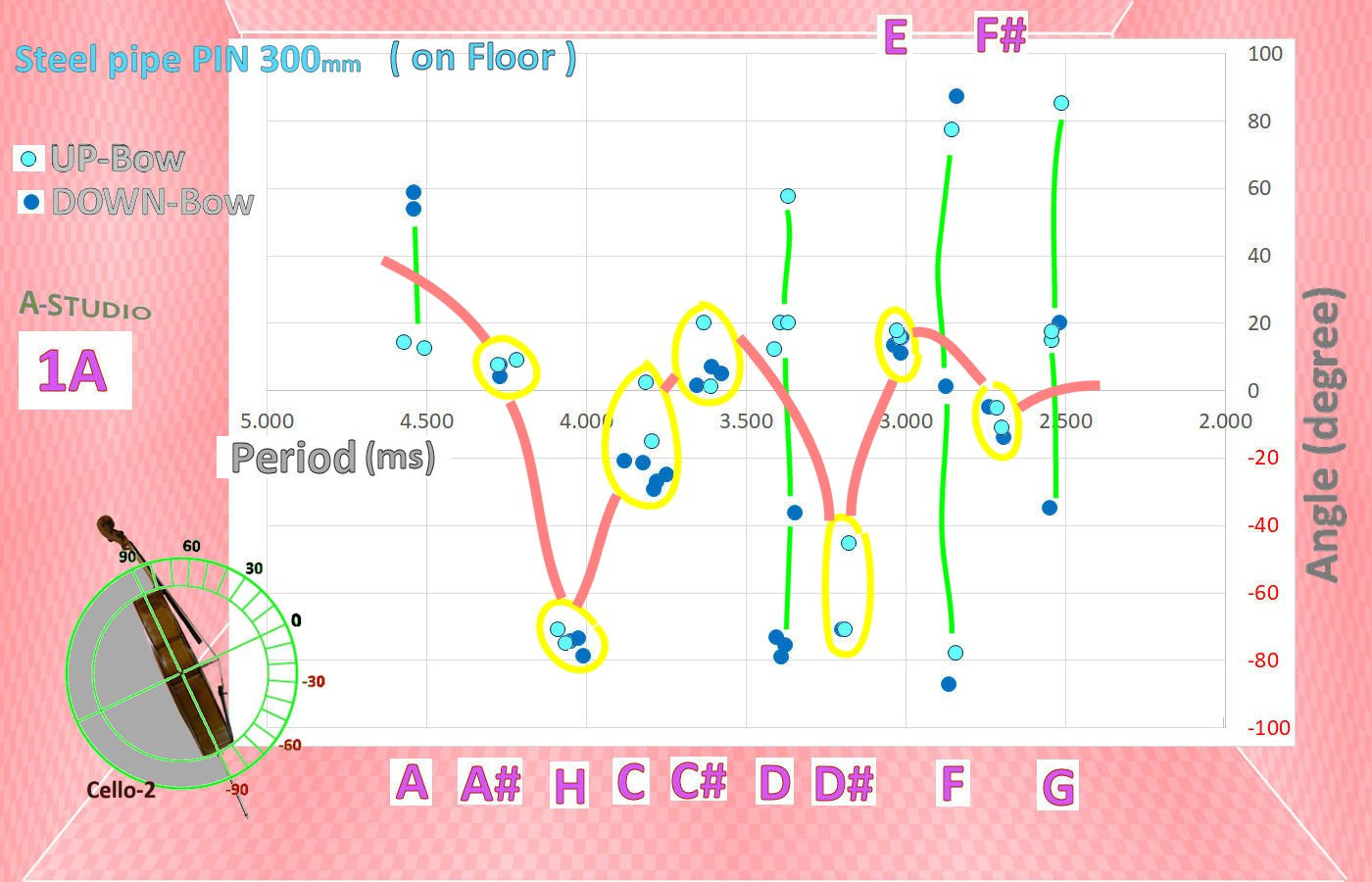
Resonance directions on cello were briefly measured at A-G chromatic semitones on A-string and also D-C semitones on D-string comparing with 'steel pipe endpin 300mmL on floor' and 'without endpin', down-bowing and up-bowing.
(1)The results can be divided into two groups; [group-a]stable, clear tendency in resonance direction, [b]diverse, taking various resonance directions. The reason of [b] is not enough clear now, probably because of the factors such as multi phases even during the target semitone, difficulties in judgement of delay/waveform, complexity, vulnerability, interruptions by external effects. Differences between down-bowing and up-bowing were unclear either.
(2)According to the frequency transition, as a long-tern viewpoint, the resonance direction seems rotating. The angle rather drifts near around 0 degree on D string, however unlikely D, the angle seems spreading/rotating wide-angle on A string.
(3)There might be a possibility that an endpin narrows down the angle range of resonance. These results might reek us a secret of the body of violin-family instruments that has been probably designed originally as being able to resonate for all-round directions.
Resonance direction measurements will be gone on by switching the examinee-instrument to CELLO-1.

Cello-2(115歳・ドイツ製)について、スチールパイプエンドピン300mmL(床置)とエンドピン無(スタンド置)で、各々ダウンボーイングとアップボーイングにて、A線及びD線上の各半音ごとの振動の方向を計測した。測定データ数は十分とは言い難いが、次の傾向が見られた。
(1)安定して独自の振動方向を示す音グループ[a]と、多様な方向を示す音グループ[b]の2グループに分かれた。
[a]は、A線上では H C# D# E F#、D線上では E F F# G G# A# であり、
[b]は、A線上では A D F G、D線上では D D# H であった。多様な方向を示す理由は、今後さらに調べる予定であるが、例えば、一つの半音域の中に多様な振動形態を持つ・位相の計算が難しい(判別しにくい)・振動波形が交錯したりつぶれたりしている・何某かの外的影響を受けやすい、などが考えられる。ダウン/アップボーイングで違いが見られるのは[b]グループである。
(2)大きく見ると、周波数の変化とともに振動方向が回転(ローテート)しているように見える。D線域では胴体の輪切り方向(=低角度)に振動することが多く回転周期も長いが、一方 A線域では 激しく変化しているように見える。
(3)エンドピン有り/無しで比較するとエンドピン無しの場合の方がわずかではあるが、多様な振動方向を取っているようにも感じられる。バイオリン属の胴体の形状・構造はそもそも多様な振動・共鳴を取りうるように設計されているのかもしれない。
次の投稿では、Cello-1を使ってもう少し多くのデータを調べてみる。


90. Resonance Direction - Calculation -

[ 12/13/2019 ]     Labels:  70.Resonance Direction

 
Each chromatic tone of cello has own characteristic waveform or the resonance direction. This phenomenon depends on the each individual instrument issue however at the same time, probably the common truth based on the structure.
Now new better-accuracy measurements are launched. The plan image is as follows ;
1.The resonance direction will be indicated as a counterclockwise angle(degrees) from the round slice level of cello body.
2.Two microphones placed at vertically and horizontally catch the cello sound wave according to each distance with the eligible delay. They are calculated as (Microsoft Excel function:) '=COS( )' or '=SIN( )'. The delay period is described as a sine curve too. This means the resonance direction can be described like '=ACOS(delay/(phase/2))...'.
3.Actually cello is not usually played at the angle of 45 degrees from the floor, but around 65 degrees. This deviation should be compensated and embedded in the calculation.
4.Overview will come out soon, but some special tones with like collapsed or complicated wave pattern will be took place a detailed testing later.
5.Begin with the checking at 'the difference down-bowing and up-bowing' on A and D string.

Celloは各々の半音で、チェロ胴体の中で振動する方向に個性があることがわかったので、さらに精度を上げて全体像を調べてみる。
この個性は個々の楽器に依存する問題であるが同時にチェロという楽器の構造に共通する現象と考えられる。
具体的進め方は次りとおりとする。
1.Celloの胴体の輪切りレベルを(角度=)0度として、振動方向を反時計回り角度で表示する。
2.水平方向マイク・垂直方向マイクの波形により、相のズレ(マイクへの音の到達遅延)がわかるので逆算すれば振動方向が計算できるはずである。
それぞれのマイクへの到達時間は、EXCEL関数では =COS( ) または =SIN( )関数で求められ、Vマイク - Hマイク の時間差も同じくサイン曲線であるので、振動方向は =ACOS(遅れ/(測定音の周期/2))... のイメージで求められるはずである。
3.現実には、測定するCelloの設置角度は水平から45度でなく、65度程度であるので、この角度差を補正する。
4.これにより音ごとの個性的な振動方向(音の飛び方向)の概要がわかるはずである。しかし、実際には、チェロの構造上の関係もあって複雑な波形の組み合わせをとることもあるし、床やエンドピンの共振の影響で方位がゆがめられたり波形がつぶれたりして明確な計算ができない場合もある。明確に方位を得られない場合は、後日手法を改良して挑戦することにする。振動している場所も推定できるかもしれない。少なくとも知識は増えるだろう。
5.まず最初に、A線・D線上の音について、ダウン弓とアップ弓で、振動方位に差があるかチェックしてみよう。


84..C(66Hz)-G(98Hz) Resonance -1

[ 08/19/2019 ]     Labels:  70.Resonance Direction

 
Cello's low notes on C-string were carefully measured under the condition: mezzo-forte, down bowing, 4 measurements per target note, sounds were monitored by microphones(deployed vertically and horizontally) and on bridge and endpin tip.
Following factors were compared:
1.Without endpin (on handmade stand, floating)
2.Carbon endpin-300mmL (on stand, floating)
3.Carbon endpin-300mmL (on 6Kg-wood board/floor)
4.Carbon endpin-300mmL (on AEH-new prototype No.420)
5.Carbon endpin-300mmL (on AEH-011)
6.Steel pipe endpin-300mmL (on floor)
7.Titanium rod endpin-300mmL (on floor)
8.8mmD metal rod endpin-300mmL (on floor)
As the first conclusion:
The amplitude of C#,D,D#,E showed less volume than F#,G.
By being restricted the endpin tip the resonance amplitude seems to be suppressed furthermore. Details/additional data will be discussed at next posts.

チェロのC線上(低音)の響きについて詳細に測定してみた。音域は G(98Hz)以下で、2つ以上のビートで1周期が構成されている領域である。チェロ演奏者としては感覚的に楽器の響きに不満を感じることの多いエリアである。
比較条件は
1.エンドピン無し、(スタンド上、浮かせて)
2.径10mmカーボンフイバーエンドピン(質量=54g)、300mmLに設定 (スタンド上)
3.径10mmカーボンエンドピン300mmL (AEH試作品No420上)
4.径10mmカーボンエンドピン300mmL (AEH011上)
5.径10mmカーボンエンドピン300mmL (6Kg木材上)
6.径10mmスチールパイプエンドピン(質量=132g)、300mmL (6Kg木材上)
7.径10mmチタンエンドピン(質量=178g)、300mmL (6Kg木材上)
8.径8mm金属エンドピン(質量=210g)、300mmL (6Kg木材上)
ボーイング(ダウン)、mf、各4回測定(F#,Gについては2-4回測定)、
音声マイクを①垂直・②水平方向約500mmに配置、③駒・④エンドピン先端付近でも収音。オシロスコープで観測した画面をスローモーションカメラで撮影して、振幅(mV)、周期(/周波数)を算出した。

まず収音した振幅(垂直・水平方向の値を合算)を比較してみる。4点の測定値を平均したもの(C-G)、各々データをすべてプロットしたもの(C#-E)を見ると、
F#-G音に比べて C#-E音の音量が小さい。床置きした場合特に振動が落ち込んでいる。浮かせた場合との差が大きかった。
AEH(試作品を含む)で中間の性能/効果を示した。エンドピン先端の自由度が大きく影響していると言える。
次回、さらに細かく見ていく。