Showing posts with label 61..Sound color-2. Show all posts

565. Cello Tone Portraits MEMO

[ 09/19/2020 ]      Labels: 61..Sound color-2


Typical tone portraits(oscilloscope waveform) of cello from C(66Hz) up to A(442Hz) have been posted up to now. These photos, oscilloscope's horizontal lattice was set as 50mS, show us two important facts.
(1) There is a regularity/resemblance in the tone portraits according to the tone name such as C,D,E,F,G,A,, when they are played by pizzicato, beyond octaves or cello instruments or endpins. This phenomenon is probably originated in the cello body structure and its dimensions.
(2) Cello seems to be able to create a single-beat waveform(noiseless, beautiful) for tones G(98Hz) and above. Skilled cello players can probably create such a simple waveform even on arco-tones. On the other hand, for low frequency notes(C:66Hz to F#:93Hz), cello body is too short to create such a long wavelength by its single-beat. When an endpin is not equipped, cello recruits some additional regular up-beats(1-4 times) by itself inside the body to make up a complete fundamental period. However if the endpin is anchored on the floor and given continuous energy, the long length wave goes through to endpin and rebounds at the floor, then brings back a noisy/interference vibration and reduces the original tone amplitude instead.
There seem to be a discontinuity fault in the resonance in and around G(98Hz) tone.
Here attached typical portrait photos of C(66Hz), G(98Hz) and D(147Hz) that are set H-lattice as 20mS to improve the resolution.

チェロの最低音(C,66Hz)からA(442Hz)までの主要音についてオシロスコープの波形(水平格子=50mS設定)を見てきた。ここでは2つの特徴があることに気づく。
(1) ピチカートから得られる共鳴波形は、音名ごとに極めて類似した姿をしている。これは、楽器が変わっても床とエンドピンの関係が変わってもあるいはオクターブが違っても共通に現れる類似形のようだ。つまり、チェロという構造・ディメンションからもたらされているように思われる。
(2) G(98Hz)以上の高音においては、全ての音でその音の基音周波数によるシンプルで美しい波形を得ることができるようだ。(厳密にはボーイング時においては一定のスキルは必要。) しかし、低音のC-F#(C線上)においては基音のみの純粋な音を得ることができない。つまり、チェロ胴体が95Hz程度以下のシングルビートを作ることができないことを意味する。エンドピンが無い時は裏拍(1-4ケ、⇒倍音とも関係がある)を補足しながらその基音周期を形成している。エンドピンが装着され床に固定され、弓を使って連続してエネルギーが供給される場合、そのエネルギーは床に向かって(長周期を求めて)流れて行く。そのリバウンド波は規則的な裏拍を形成できないで雑音のようにフィードバックされ、C-F#ではその雑多な振動が混在する。
チェロは、G(98Hz)の上下で響きのルカニズムが異なっている。
添付の写真は、C(66Hz)、G(98Hz)、D(147Hz)の典型的な波形である。ここでは水平格子幅を20mSに拡大してある。C(66Hz)ではピチカートの場合、3-4ケの裏拍を伴って15mSの基音周期を形成しているのがわかる。


565k Portrsits-DGC-comparison_1400x900

565. Cello Tone Portraits -A-

 [ 09/17/2020 ]      Labels:  61..Sound color-2,

565g 1AtG-1AvA_1400x900

565f 1A7E-1A8F_1400x900


565d 1A0A-1A2H_1400x900

56. Response TOPICS -2- Wolf tone

 [ 09/06/2020 ]      Labels: 61..Sound color-2,  63.Wolf tone

 
Many oscilloscope screenshots hint us a regularity in their resonance spectrum according to the tone name such as C,D,E,F,G,A,, only when they played by pizzicato. Each tone's spectrum shape seems very resembling beyond octaves or cello instruments.
The first two screenshots are typical E(166Hz, second semitone on D string) spectrum of pizzicato and short arco attack. They are all consisted of 6mS(E,166Hz) fundamental vibration and seem as if they are totally twisted or rolling.
The last two screenshots are very unique: E(almost 166Hz, 9th semitone on E string) wolf tone in pizzicato and arco long tone. The amplitude of wave regularly/irregularly dies away and recovers again.
Wolf tones probably relate to the simple/inflexible resonance of top-plate of cello.

オシロスコープで多くのCelloの音波形を見ていると、pizzicatoの波形は オクターブや楽器の違いとあまり関係なく C-D-E-F-G--等の音名ごとで極めてよく似ていることに気づく。例えば、E(166Hz, D線上第2半音)の典型的な波形は、最初の写真のようである。(上:ピチカート、下:短いアルコ・アタック)、6mSの基本周期で規則的に振動しながらねじれている(あるいはローリングしている)かのように見える。
下の写真は、その特殊なケースであるのウルフトーン(G線上の第9番半音付近で観察)をとらえたユニークな写真である。(上:ピチカートの中のウルフトーン、下:アルコの伸ばし音の中のウルフトーン)。途中一端振幅がゼロになっては復活している。
おそらくウルフトーンは表板のシンプルな振動と関連があり、厳格に左右対称に作られた楽器で起こりやすいのだろう。いづれもオシロスコープの水平格子幅は50mS。


61..Fine vibrations in sounds

[ 06/07/2019 ]     Labels: 61..Sound color-2

 
Fine elementary vibration frequencies/periods(ms) were adopted to X-axis instead of the fundamental frequency/period(ms).
Patterns of 'WithoutPin' and 'CarbonPin' were very similar, but metal endpins took rather characteristic patterns.
These patterns seem as a kind of 'voiceprint', and probably come out as sound color. The highest frequency was found at 1A-G- of titanium endpin as 0.417ms(corresponds to around 2400Hz -D-)

測定音の基音の周期(ms)ではなく、観察された最も細かな振動の周期(ms)を横軸に、音データの振幅を縦軸にとってみた。
その結果、カーボンエンドピンのパターンが最もピン無しの場合に近かった。つまり音色がよく似ていることを意味する。また比較的に全体に連続して分布している。
一方、金属系エンドピンでは、周波数域が特徴的で、一種の「声紋」のようにも見える。音色の違いが感じられる。チタンエンドピンでは最高周波数がみられた。0.417ms、約2400HzのD音に相当する。


61..Low notes(on C string) take Turning-back-resonance?

[ 06/04/2019 ]     Labels: 61..Sound color-2

 
When cello's 46 chromatic sounds were plotted according to 'period'(:X-axis) and 'period of the dominant beat'(:Y-axis), a discontinuity came out at around G-F# on C string.
Skilled players can probably create a beautiful one beat(/group) waveform for many notes on A, D, and G strings. However, for low notes on C string(:C to around F#), the resonance is separated to two vibrations like a down-beat and an up-beat instead. Does this phenomenon('turning-back-resonance'??) relate to the length of cello body/string?

横軸に周期(ms)を、縦軸に一番卓越した振動(拍)の周期(ms)を取って作表してみたところ、「不連続」が確認された。
A線・D線・G線上の音においては、丁寧なボーイングを行い条件が整うと、多くの音符について、その音の1周期当たり1ケの(美しい)波形、あるいは微振動を伴いながらも全体として一つのまとまった波形の音を作ることができそうである。しかしC線上の低音(F#付近以下)では二つ(以上)に分割されてしまう。チェロの胴長が不足して折り返し振動しているのか、弦や胴体が表拍・裏拍に分割してタイミングをとっているのか。チェロ奏者は自分の(低)音に貧弱さを感じることがあるが、関係があるのだろうか、チェロの構造的な問題が隠されているのか、あるいはエンドピンがさらに話を複雑にしたり加速しているのだろうか。


61..Mechanical Resonance on Endpin

[ 05/31/2019 ]     Labels: 61..Sound color-2

 
Mechanical resonance on cello-endpin(taking a remarkable amplitude and simple mechanical vibration waveform) was reviewed again and marked.
They are seen at the specific frequency(note) and its overtones and the surrounding, consequently covering around 50% of whole chromatic notes.

各エンドピンで、大きな振幅を伴って機械的(波形もシンプルな)共振をしている範囲をあらためてまとめた。
特定の音階とその倍音とその周辺で見られる。大まかに半音階全体のの50%程度で見られた。


61..Sound(TopPlate) Amplitude Comparison

[ 05/28/2019 ]     Labels: 61..Sound color-2

 
Measured sound amplitude data(considered to be equivalent to the vibration of top-plate) were compared between 'without-pin' and other carbon, steel pipe, and titanium endpins.
Carbon fiber endpin has the most resemblance to 'without-pin'. According to increasing pin weight, the resonance pattern seems to shift away slightly. In a case of titanium endpin, at low notes(:periods are over 8ms), endpin might be bringing a muting effect.

音データ(=表板の振動、振幅)を各々のエンドピンとエンドピン無しとで比較した。
エンドピン無しのオリジナルの振動(振幅)パターンに対して、カーボンエンドピンの場合が最も近いように思われる。エンドピンの質量が増すにつれて振動パターンが少しづつシフトしていくようだ。チタンエンドピンでは低音側で若干振幅が減少(ミュート効果)しているかもしれない。


61..Chromatic Data Review -2019- (2)

[ 05/26/2019 ]     Labels: 61..Sound color-2

 
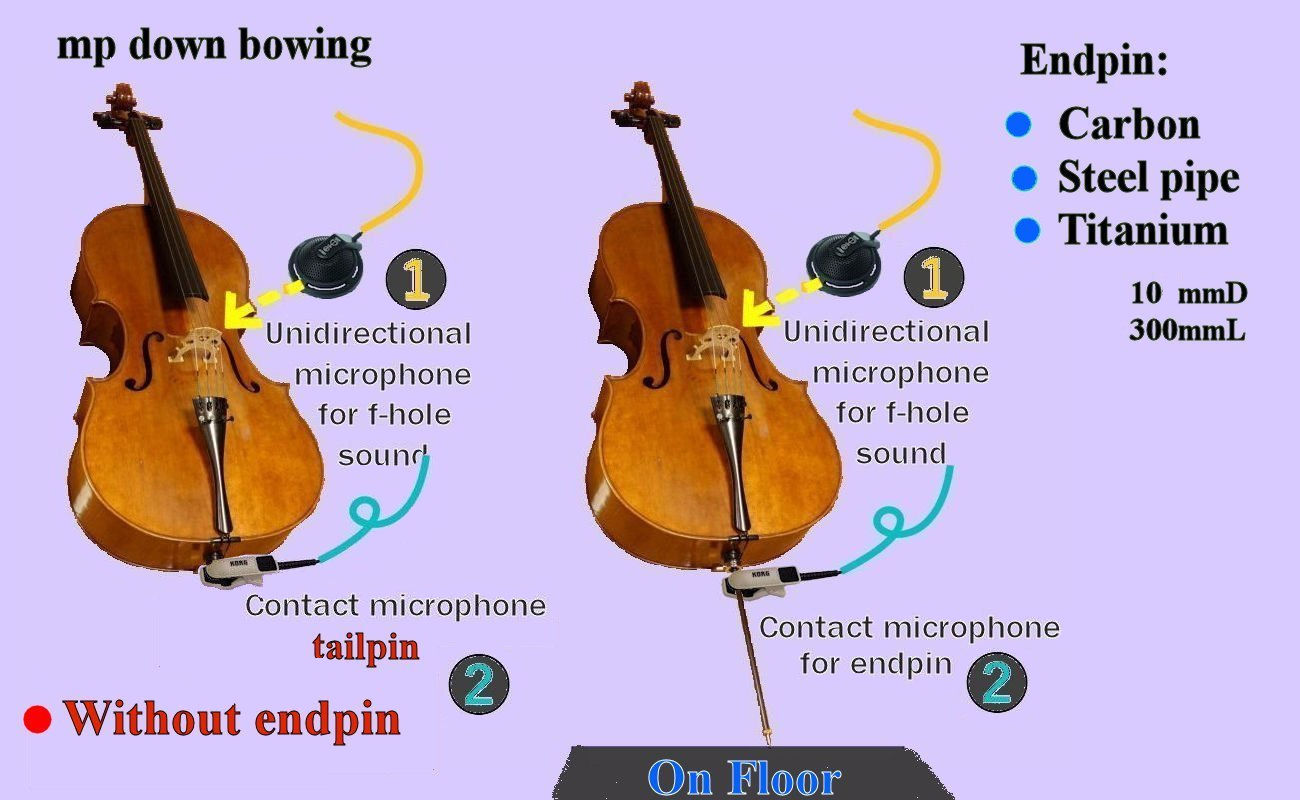
Cello's 46 chromatic data measured last year, A(442Hz) to C(66Hz), played mezzo-piano and arco, with 3-material 300mm-length endpins, are being reviewed closely again.
How can endpins(and the floor) influence cello's sound color/mechanical resonance? Can we see it graphically?

When 64 chromatic notes on 8-year-old cello was bowed without endpin, following notes took rather large amplitude at sound data on oscilloscope: A(442Hz), F, C, A, F, E, A#, G#, F#, F, D#, C(15Hz). Whereas, F, E, D notes were observed as a soft amplitude at tail-pin(bottom).
This tendency probably means that each note has a favorite resonant direction in cello body.

If a cello deploys an endpin and the two points of endpin are fixed between tail-pin and the floor, endpin resonates/react to specific tones and the overtones according to the endpin length and the material. These frequencies are unfortunately overlap the sound range of cellos.
For instance, a 300mmL carbon endpin remarkably and mechanically resonated to D(295Hz), A, D#, D, G#, G, D#, D, C#(70Hz).
Steel pipe and titanium endpin seem to take slightly shifted frequencies and resonance patterns.

エンドピン無しの場合、測定音(=表板振動に相当)では、高音側より A, F, C, A, F, E, A#, G#, F#, F, D#, C で大きい振幅が見られ、逆にテイルピン(底板)側では、F, E, D で共鳴振動が小さかった。
音(周波数)により、チェロ胴体の中で共鳴する方位が異なっていることが予測される。

エンドピンを装着した場合、先端が床で固定されるとエンドピンはその長さ(・材質)により特定の周波数に共振するようになる。(不幸なことに、エンドピンの共振周波数はチェロの音域と重なっている。)
この測定では、例えばカーボンエンドピンの場合、高音側より D, A, D#, D, G#, G, D#, D, C# で顕著な共振がみられた。
金属系エンドピンの場合は少しづつではあるが、共振周波数とパターンがシフトしているようだ。


61..Chromatic Data Review -2019-

[ 05/24/2019 ]     Labels: 61..Sound color-2

 
Cello's 46 chromatic data measured last year, C(66Hz) to A(442Hz), played mezzo-piano and arco with 3 kinds of 300mm-length endpin, are being reviewed again.
How can endpins(and the floor) influence cello's sound color/mechanical resonance? Can we see it graphically?

昨年測定したチェロの C(66Hz)-A(442Hz)の 46ケの半音階データ(エンドピン=無・カーボン・スチールパイプ・チタン、いずれも長さ=300mm、mp、arco)について、再度、細かくデータを分析をしてみよう。
注目すべき点は、エンドピンの違いによる振動の違いを数値化・グラフ化することにより、エンドピン(および床)が音に対して及ぼしている影響・兆候を予測することことができるか。まず始めに、周期を横軸(対数軸)として振幅をプロットしてみる。